Now go outside and look at the sky.
Astor House: Running Away
This post was inspired by a very dramatic photo from 1937, but I had originally been looking at it for a completely different reason than the obvious wave of humanity in a state of panic.
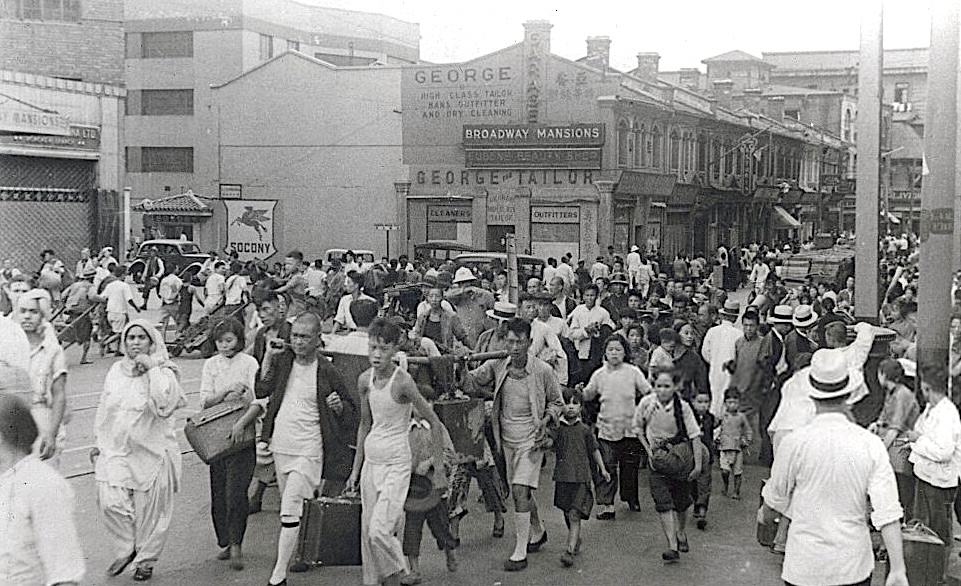
In two previous posts I've mentioned the Bridge-Head Cafe & Bar and the lack of any further photos of that place. This photo is centered on the same building in 1937 - three years after the Broadway Mansions were built, wiping out the old Mactavish pharmacy, which would have been to the left in this shot. But the Bridge-Head bar has not moved in yet - the earliest we have is a film from 1946 showing the bar.
In this photo, that location is occupied by "George The Tailor", which apparently just moved into that location in this very year.
The facade of this building facing south - towards the Garden Bridge - has two additional ads: One for the Broadway Mansions Garage, which was located to the left of this building in the little alley behind the Broadway Mansions and another ad that is very hard to read in this photo for a Beauty Shop (Ruben's? Euben's?), which was probably upstairs above the tailor.
To the left of the tailor in the back section of the building we see an ad for "Socony" with a winged pegasus, which undoubtedly was red on white - this is an ad for Socony Mobil Oil - a predecessor of Mobiloil, which kept the red pegasus as a logo for a long time all through the 20th century.
One more note about the shops along Broadway, slightly out of focus with most of the signs not readable. The one exception is the Astoria Confectionary & Tea Room with it's tall vertical sign halfway down the block. Okay - two exceptions: All the way on the right we can see a partial few of the sign of H. Oliveira & Son which moved to this location in 1936.
But now to the real focus of this photo - the date is probably around the middle of August 1937 and this is the result of the first days of the Battle of Shanghai. A wave of refugees is fleeing from the fighting between Japanese and National Chinese troops, which will devastate large parts of Shanghai over the coming three months.
The area north of Soochow Creek was de-facto under Japanese control since about 1931, and in 1937 the National Chinese leadership decided to wrest back control with an all-out attack by air, sea and land-based artillery and troops. This led to 100,000s of residents of Hongkew and other areas north of Shanghai attempting to flee to the International Settlement, and the Garden Bridge was one of the main paths to the south across Soochow Creek.
It's worth to zoom in on all these faces. Parents fleeing with their children, people carrying a suitcase and nothing else as they leave their homes behind. They don't know it yet, but many of these refugees will never be able to return to their old homes as the Japanese occupation will last for eight more years.