Now go outside and look at the sky.
Astor House: New Immigrants In The War Zone
For this post we are mostly going to stay in the late 1930s, which was a time of rapid social change in Shanghai accompanied by pitched battles in the streets between the Japanese troops on one side and a lose coalition of Chinese military forces from both the Communist and Nationalist side as well as various armed contingents of the colonial powers.
While the war in China was heating up, Shanghai was still a free port where anyone could set foot on land with very few limitations. Thousands of mostly Jewish refugees made their way across half the globe to escape Nazi Germany and their only hope was this city that promised a safe haven, no questions asked. Most of them were settling in the old International Settlement with its southern border being Suzhou Creek and the Garden Bridge.
Broadway near the Astor House as well as other streets in the area were rapidly developing a decidedly Central European atmosphere, with new shops springing up with Russian, Polish and German names. Many of these newly arrived refugees opened shops in storefronts recently vacated by Chinese families as Japanese troops asserted increasing control over parts of the International Settlement.
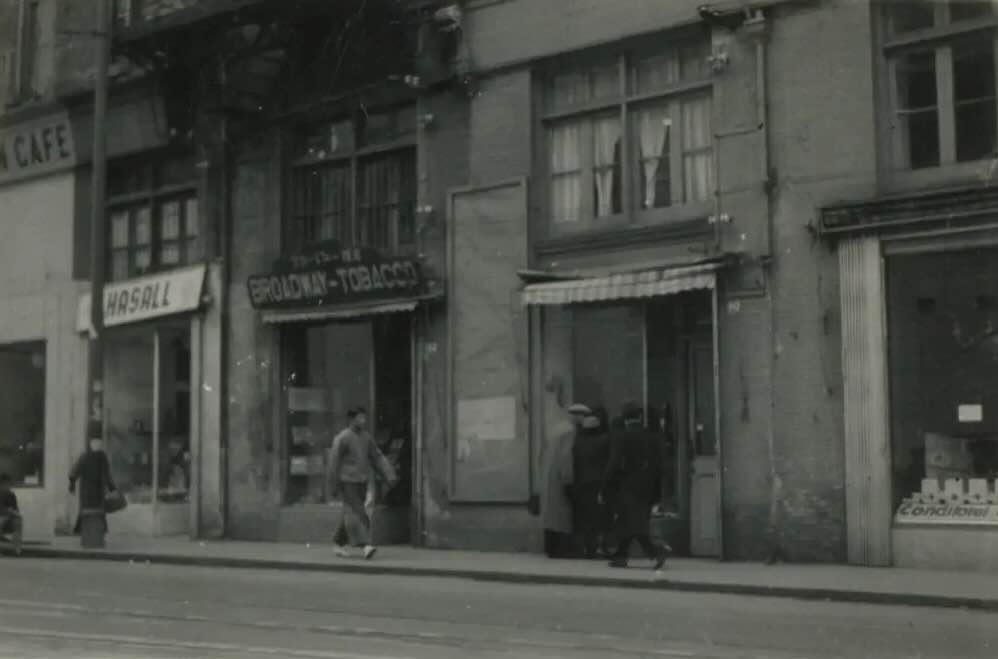
We see this rapid change here in these store fronts in the back of the block of the Astor House. This first photo shows the row of stores next to the Broadway entrance of the Astor Bar, beginning with the Swan Cafe, Hasall, Broadway Tobacco, an unidentified store that seems to attract a lot of rubbernecking onlookers and a German-speaking pastry shop - a Conditorei at 78 Broadway.
The full name of this cake shop is Conditorei Felicia and in 1939 it was operated by Alfred Schaffer (also listed as Alfred Schiefer), most likely a recent immigrant.
While writing this post I was wondering about the name Hasall. This photo is attributed to 1939, and with that name I found this article (in German) about Hans and Grete Salomon. They had a shoe and clothing store called Hasall in Celle, Lower Saxony, and like many Jewish businesses it was destroyed in the Reichskristallnacht. Hans ended up in the concentration camp Sachsenhausen, but was temporarily released in December 1938. He and his wife emigrated to Shanghai in early 1939, before moving on to the USA in 1940. I have no doubt that this store here - Hasall - is their store in Shanghai only a few months after arriving in town.
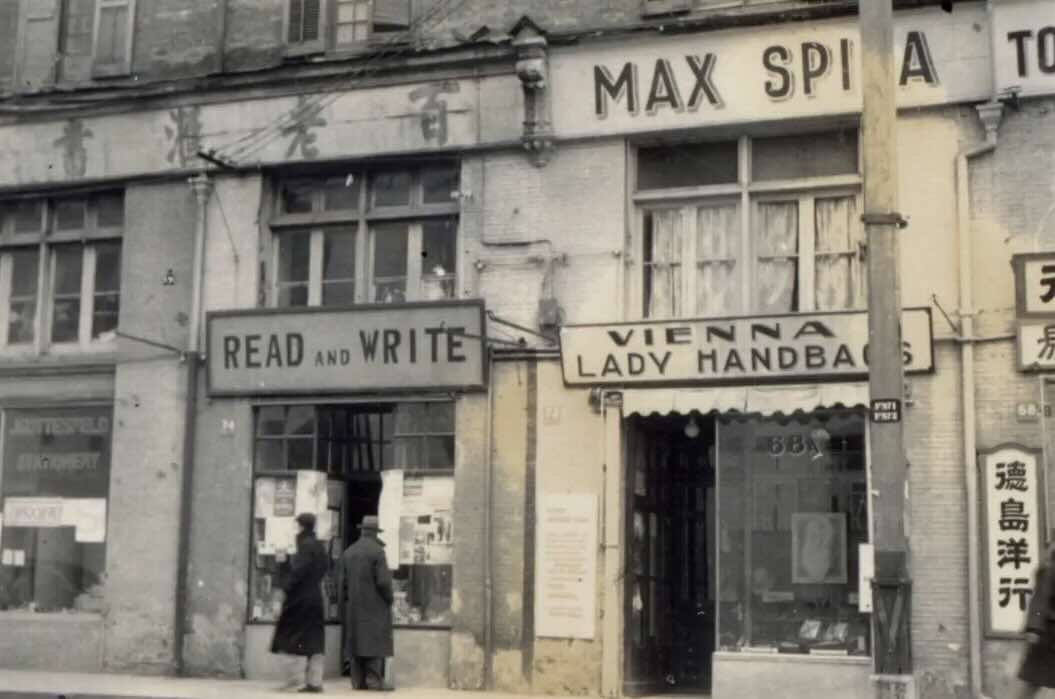
Update June 2026: I rewrote this whole section, as I found so much more information about essentially everything in this second photo.
The photo is only a few stores further along Broadway from the first one above. We are in the middle of the block on Broadway that forms the back of the Astor House building cluster.
The leftmost store window is cut off in this photo and is unfortunately nearly unreadable, but the name seems to end in "...TTESFELD" and the second line ends possibly with "...MEAT". Now this should technically be 76 Broadway, but the house numbers here shifted several times in the 1930s.
By 1939 - the time of this photo - the store at 73–75 Broadway, the neighbor of Read And Write, was listed as a German Butcher & Restaurant - the name of the owner at this time is still unclear, but this Butcher and Restaurant had been established at that address around 1930 by Fritz Pasche and predates the influx of Jewish refugees later on. It went through several rapid changes in ownership during the early 1930s.
Now, while writing this I stumbled over these two scans of a cover of a Pasche's menu that was at auction recently.
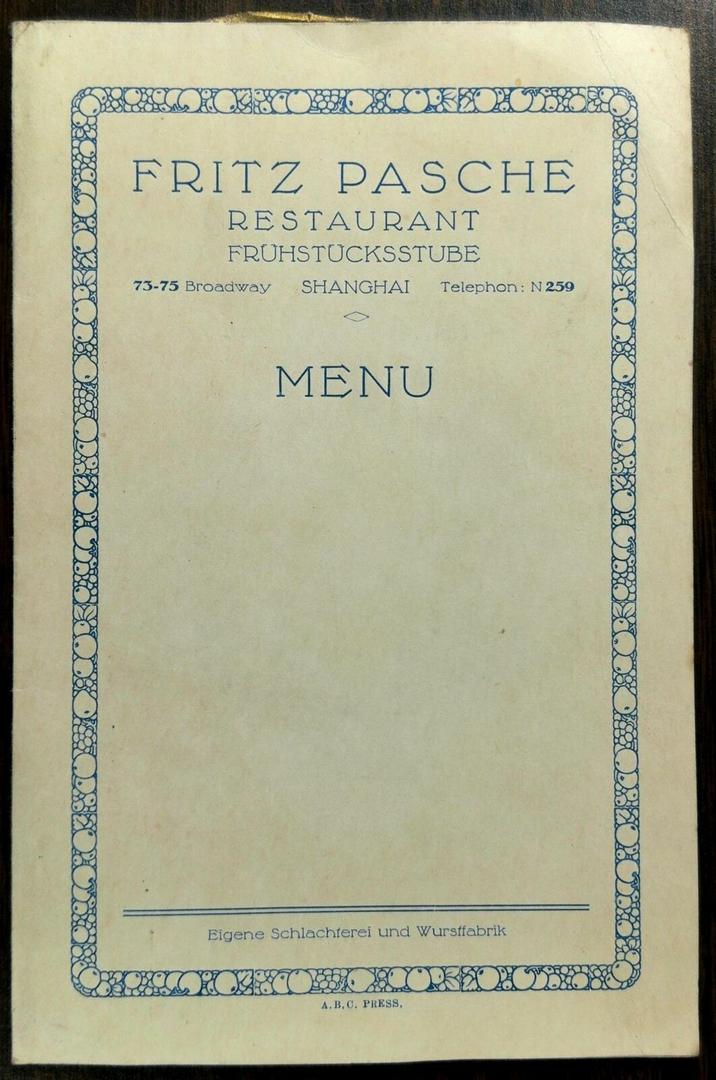
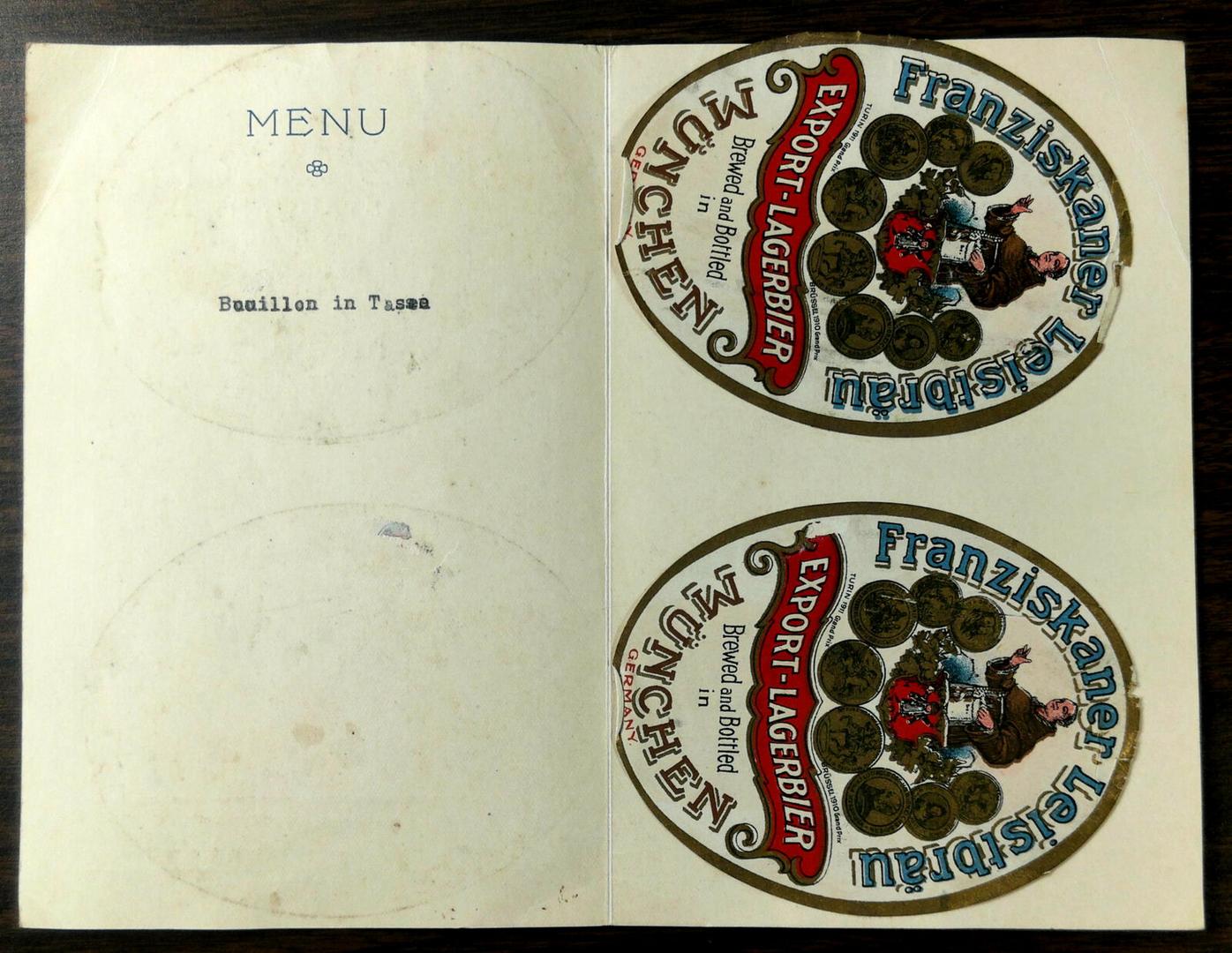
The inside only has one item typewritten: Bouillon in cups. Normally the restaurant would have a typewritten menu that would go inside of this cover, but that was not retained. Although whoever took the cover from the restaurant as a souvenir actually peeled two Franziskaner Beer labels off their bottles and stuck them in this cover - probably to remember a day in 1930 when they visited this place and had a good time.
Now moving on from the restaurant, the next store is the enigmatic "READ AND WRITE". The Jewish Refugee Directory has information about READ AND WRITE: Located at 74 Broadway, it operated as a Schreibwaren Laden (stationery store) and Leihbücherei (a lending library). In 1937 it was still listed as a Handicraft shop, so the owners of Read And Write were recent emigrants from central Europe and established this store in 1938.
The next store to the right is the Vienna Lady Handbags with the additional name higher up above the windows "MAX SPI...A". This was a mystery until now, but I recently found in the 1939 "Emigranten Adressbuch" (Jewish Refugee Directory): "Spiro, Max, Wien, Kfm. 72 Broadway".
There is a faded house number "72" next to the Vienna Handbags store and Max Spiro - a merchant from Vienna - had this address in the register of Jewish refugees. So when Max left Vienna and landed in Shanghai he must have decided to start the Vienna Lady Handbags business under the name Max Spira... It's certainly not a typo since those hand-painted letters are nearly half a meter tall!
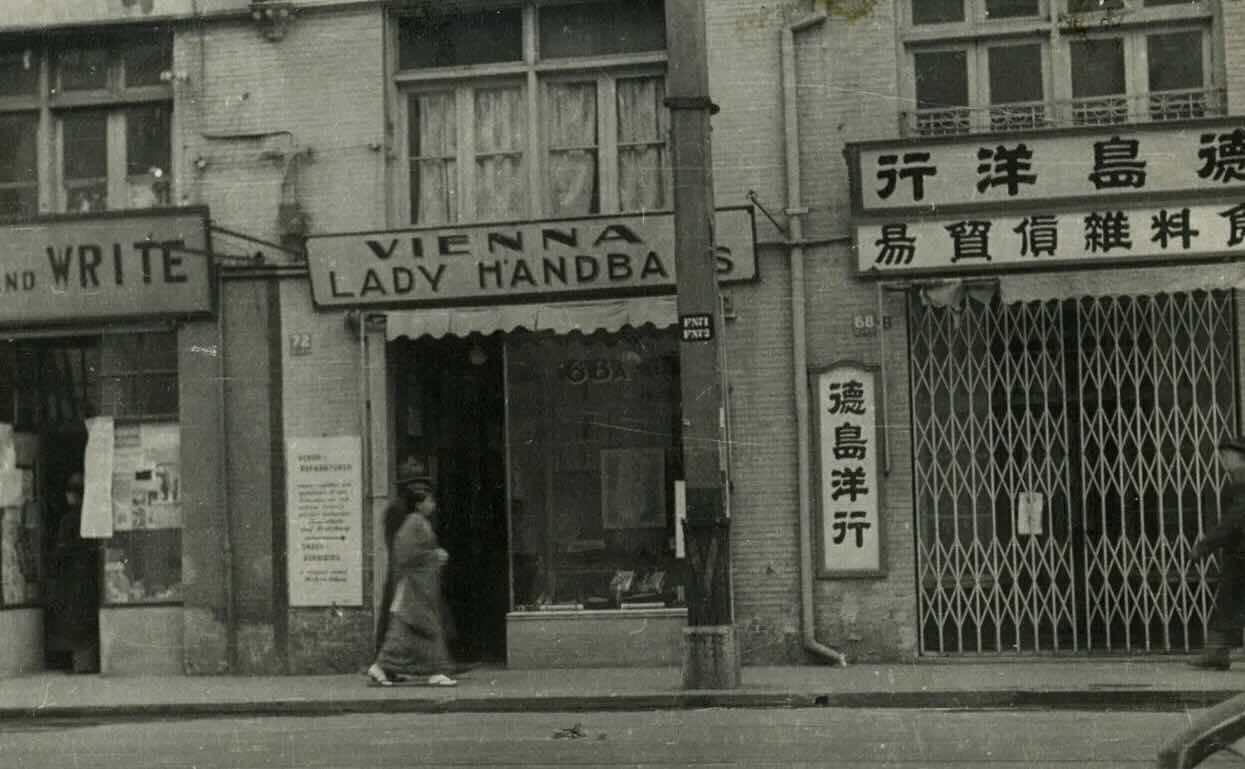
Another shot from the same day in 1939 of the "VIENNA LADY HANDBAGS" store. I would love to read that proclamation on the wall next to the store there.
I have not been able to fully identify the store to the right - it seems to be a travel supplier - 70 Broadway has a listing for "Oriental Luggage Factory" in the early 1930s, so that might be a match. And here the number in the photo is actually 68, but as mentioned above, the addresses here were in flux.
There is a trap waiting for any other researchers of this block - there is a famous Eddie's Cafe (after 1930 Browning's Cafe) at 68 Broadway, but that is the pre-1930s numbering along Broadway and is one block further east along this road beyond the Hanbury Coffee House and the curio shops we visited before.
1939 was a year with many changes along this block of Broadway with a huge influx of refugees from all over central Europe. Later, around 1943, the Japanese occupation forces partially gave in to pressure from their German allies and forced Jewish refugees from all over Shanghai to re-settle in Hongkew in what rapidly became a Ghetto. The Japanese did not send any of the refugees back to die in German concentration camps, but the living conditions would become extremely harsh with only very limited food available to the refugees until the war would end.
It will stay tense for our next post, as we will stroll a few more storefronts to the right, further towards the corner of Broadway and Seward Road.